Around one in twelve men and one in two hundred women have some form of colour vision deficiency – and a good many of them have no idea. Without being able to compare the way we see with the way others do, colour blindness/colour vision deficiencies can remain undiagnosed for years. Often, it is discovered in routine eye tests, at childhood or sometimes in people’s forties or fifties.
Colour blindness affects our vision through cone cells in the retina, each responding to a different band of light – red, green or blue. When one type of cone is missing or less functional, we can stop being able to differentiate between certain shades of colour.
This might be a difference that we’re born with, but colour vision can also shift later in life through cataracts, diabetes, glaucoma or some medications, which is one reason a sudden change is worth mentioning to an optician. If you want to go deeper on this topic, ZEISS has a detailed explainer on red-green deficiency.


What are the symptoms of colour blindness/colour vision deficiencies?
Given that we may consider our own vision normal, it can be difficult to notice colour blindness. Often, it's only spotted when other people report a distinction in colour that you can't yourself find.
That could mean a teacher querying a child's colouring, a partner insisting that two items of clothing don’t match, or a pie chart at work whose segments are hard to distinguish.
What are the different types of colour blindness/colour vision deficiencies?
Red-green deficiency is by far the most common, and splits into difficulty with green (deuteranomaly) and difficulty with red (protanomaly).
Blue-yellow deficiency, or tritanomaly, is much rarer and tends to blur blues with greens and yellows with pinks.
Rarest of all is achromatopsia or total colour blindness, where colour drops out altogether and the world is viewed in shades of grey.


Can women be colour blind?
Yes, although the condition is far rarer in women. The genes that cause the condition live on the X chromosome. Men have one X, so a single faulty copy is enough. Women have two X chromosomes and the second usually makes up for a deficiency in the first.
This means that women are more often carriers of colour blindness rather than colour blind themselves. It’s only when women inherit the relevant gene on both chromosomes that they will be colour blind.
How do I know if my child is colour blind?
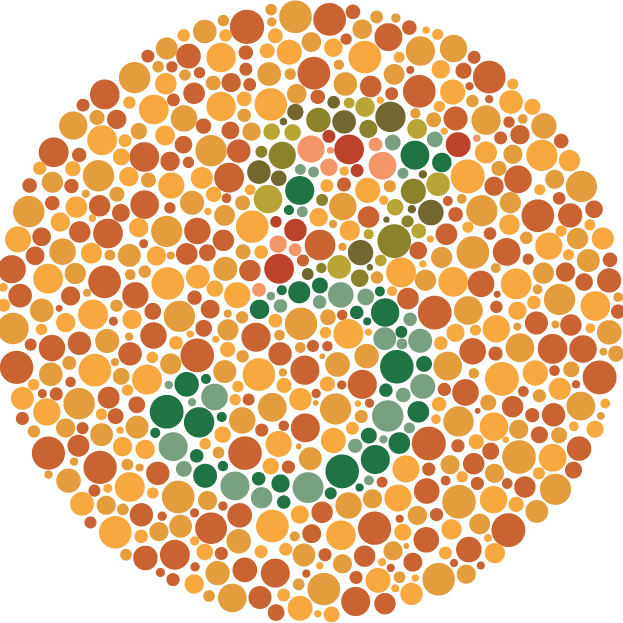
Colour blindness in children may not come to light without a specific test. Colour vision isn't always included in routine school screening, so it's worth asking an optometrist to check it directly – ideally before your child starts school, when colour-coded learning begins.
The test is quick and straightforward, and versions using shapes and pictures exist for children too young to read numbers.

How do people live with colour blindness?
Most people can manage colour blindness well by relying on other cues as well. Traffic lights can be read, for example, by the position of the light rather than the colour.
It’s possible to label clothing by its colour, and now smartphone apps will identify colours on demand. Tinted or filter lenses can also be used to improve the contrast between certain shades for some people, though results may vary.
A skilled optician can advise whether they’re worth trying for your vision.
Book your next eye test
If you think you or someone you know may be colour blind, a test is easy to book. A standard eye test takes very little time, and you can ask your optometrist to include a comprehensive colour check.